
Best PLC Power Supplies for Industrial Panels
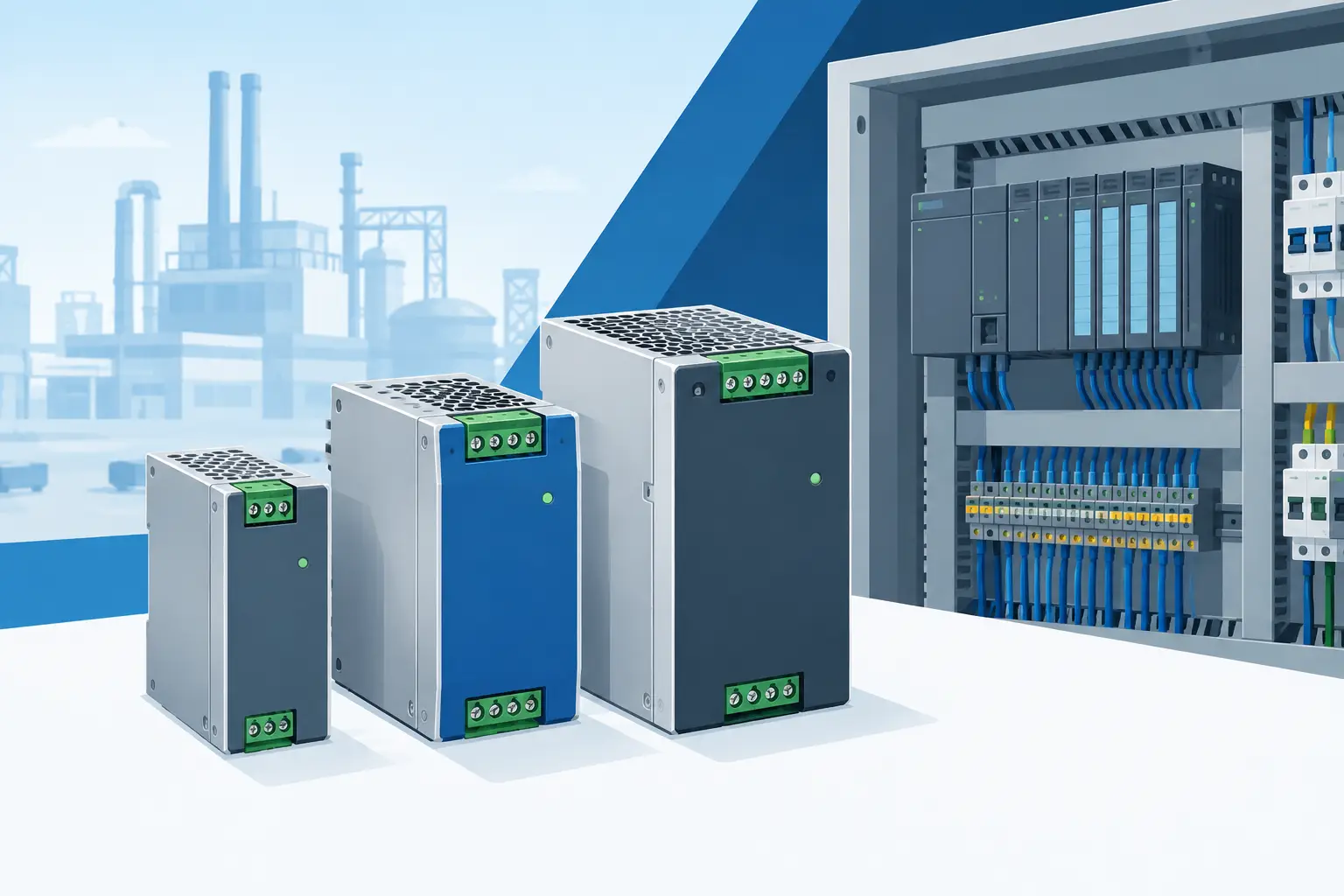
A 24 VDC power supply can be a small line item on a panel bill of materials, but it supports every PLC, sensor, relay, HMI, valve manifold, and network device connected to that control system. Selecting the best plc power supplies means matching the unit to the actual load, electrical environment, panel space, and uptime requirement - not simply choosing the lowest-cost supply with the right output voltage.
For maintenance teams and panel builders, the correct replacement is often defined by more than voltage and amperage. Input range, terminal layout, approvals, DIN-rail fit, overload behavior, and compatibility with existing redundancy or buffer modules can all determine whether a replacement can be installed quickly and put equipment back into service.
What Makes the Best PLC Power Supplies Different?
Most PLC control panels use a regulated 24 VDC supply, yet not all 24 VDC supplies perform the same way. Industrial units are designed to operate within specified temperature ranges, tolerate electrical noise, mount securely on DIN rail, and protect the output during overload or short-circuit conditions. These details matter when a power supply is feeding sensitive controls in a packaging line, conveyor system, process skid, or machine cell.
The best choice depends on the installation. A compact 2.5 A supply may be appropriate for a small PLC, a few discrete I/O points, and basic sensors. A larger machine with remote I/O, safety controls, servo interfaces, barcode readers, valves, and operator terminals may require 10 A, 20 A, or higher capacity. The load profile matters as much as the total nameplate current.
Established automation manufacturers such as Siemens, Schneider Electric, Omron, ABB, Allen-Bradley, Phoenix Contact, Mitsubishi Electric, and Delta offer power supply families intended for industrial control applications. Selection should start with the exact electrical and mechanical requirements, then narrow to the manufacturer and model family that fits the installed system and procurement standard.
Start With the Load, Not the Supply Rating
A power supply should have enough continuous output capacity for normal operation with practical headroom for future additions and transient demand. Add the current draw of the PLC CPU, local and remote I/O, HMI, sensors, communication devices, interposing relays, solenoid valves, and other 24 VDC loads. Use manufacturer specifications rather than assumptions, especially for devices with peak or startup current.
A common planning approach is to size the supply above the calculated steady-state load rather than operate it at its maximum rating continuously. The right margin depends on ambient temperature, enclosure ventilation, expected expansion, and the behavior of connected loads. A panel that runs reliably at room temperature may have less available output capacity in a hot enclosure.
Inductive devices deserve separate attention. Solenoids, contactor coils, pneumatic valve islands, and certain motors or drives can create switching transients and startup demand. Electronic circuit breakers, selective protection modules, or separately protected output groups may be required when a fault on one branch cannot be allowed to remove power from the entire PLC system.
Continuous Current and Peak Current Are Not the Same
A 10 A supply is not automatically suitable for every system calculated at 9 A. Check whether the connected equipment has inrush current and whether the supply can support temporary overload conditions. Some industrial power supplies provide extra current for a defined period to help start capacitive loads or trip downstream protective devices. Others are intended primarily for steady, regulated loads.
This distinction is particularly relevant when replacing an existing supply. If the original unit has a power-boost or overload feature, a basic replacement with the same nominal output rating may behave differently during faults or startup.
Match the Input Side to the Panel
Input compatibility is a frequent source of ordering errors. Many PLC power supplies accept a wide-range single-phase AC input, often covering common North American control voltages. Others require a narrower AC range, DC input, or three-phase input. Verify the available incoming power, upstream protection, wire size, grounding method, and required approvals before selecting a part number.
Single-phase supplies are common in machine panels and small control enclosures. Three-phase power supplies can be a better fit for higher-output applications because they distribute input loading and may offer improved performance for larger DC systems. They are not a direct substitute, however. The panel must have the correct incoming source and wiring arrangement.
For facilities with unstable utility power, frequent voltage dips, or long feeder runs, review the supply's allowable input range and hold-up time. A supply that stays within regulation through short disturbances can reduce nuisance resets, but it is not a replacement for a properly designed uninterruptible DC system where ride-through is required.
Choose the Right 24 VDC Output Architecture
The standard nominal output for PLC controls is 24 VDC, but the architecture behind that rail matters. A basic regulated supply is adequate for many standalone panels. Higher-consequence applications may need redundancy, buffering, monitoring, or distributed circuit protection.
Redundant power supplies use two independent units, typically with a redundancy module, to support the same critical load. If one supply fails, the other remains available. This arrangement is common where a PLC shutdown would stop production, create a safety concern, or require a difficult restart sequence. Both supplies and the redundancy device must be rated correctly for the intended shared or backup load.
Buffer modules and DC UPS systems address a different problem: temporary input-power loss. They store energy and maintain the 24 VDC rail for a specified period. That can give a controller time to save data, complete a controlled stop, maintain communications, or ride through a brief power interruption. Runtime depends on load and stored energy, so it must be calculated rather than assumed.
For larger panels, electronic circuit protection modules can isolate a shorted sensor cable, valve, or field device before it collapses the main control voltage. This can prevent a local fault from resetting the PLC and every device on the same supply. It adds cost and panel space, but the benefit is clear when troubleshooting time or production loss is significant.
Mechanical Fit and Environment Matter
Before ordering, compare width, height, depth, DIN-rail mounting style, terminal access, and clearance requirements with the installed unit. A supply that fits electrically may be difficult to wire in a crowded enclosure or may block duct covers, disconnects, or adjacent modules.
Temperature ratings should be reviewed against actual enclosure conditions, not only the plant's ambient temperature. Heat from variable frequency drives, transformers, contactors, and tightly packed power supplies can raise the internal temperature substantially. Check derating curves to determine available output current at the expected operating temperature.
Also verify vibration requirements, ingress protection expectations, and whether the application needs conformal coating or specialized environmental ratings. A climate-controlled electrical room and a washdown-adjacent production line are different applications, even when both use a 24 VDC PLC rail.
Replacement Parts: Verify More Than Voltage and Amps
When a power supply fails, the fastest path is usually to identify the manufacturer, exact model number, output rating, input specification, and installed accessories. Photograph the nameplate and terminal markings if available. Confirm whether the original unit feeds a standard load, a redundant system, a buffer module, or protected output branches.
A direct replacement is generally preferred when panel modifications are not practical. If the original model is unavailable or obsolete, compare dimensions, wiring terminals, mounting, input range, output capacity, approvals, and accessory compatibility before approving an alternative. An equivalent-looking supply may require rewiring, different overcurrent protection, or changes to the redundancy arrangement.
For new panel builds, standardizing on a known power supply family can simplify spare-parts planning and maintenance. It is still worth confirming the exact SKU for each current requirement. A common form factor does not guarantee that every model has the same overload behavior, diagnostic contacts, communication capability, or accessory support.
A Practical Purchase Check Before Ordering
Use the application data already available from the panel drawing and bill of materials. Confirm the required DC output voltage, calculated continuous current, peak demand, available input voltage, mounting dimensions, operating temperature, and required certifications. Then check whether the system needs fault isolation, redundancy, or stored-energy support.
For MRO purchases, include the existing part number and any accessory module part numbers in the request. This prevents a standard 24 VDC unit from being ordered where a redundancy-compatible or UPS-ready model is required. It also helps procurement teams source exact branded replacements across Siemens, Schneider Electric, Omron, ABB, Allen-Bradley, Phoenix Contact, and other major automation platforms without losing critical compatibility details.
The right power supply is the one that keeps the control voltage stable, fits the existing panel, and can be replaced without introducing a new failure point. Treat it as a core control component, document the exact part number, and keep the correct spare strategy aligned with the cost of downtime.